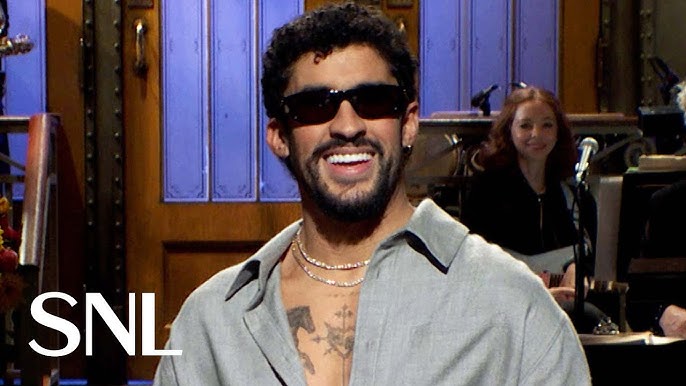

When Bad Bunny took the Saturday Night Live stage as host, he brought more than charisma and comedy, he brought culture. And when he closed his monologue in Spanish, it wasn’t just a stylistic flourish. It was a statement.
In a world where English often dominates American pop culture, Bad Bunny’s choice to speak directly to his audience in Spanish was a powerful act of representation. For millions of Latinx viewers, hearing their language on one of television’s most iconic stages was both validating and emotional. For others, it was a reminder that America’s cultural fabric is multilingual and multifaceted and it’s long past time mainstream spaces reflect that.
Too often, artists of color are expected to assimilate and tone down their heritage as well as “neutralize” their accents to make their art more “universal.” But Bad Bunny has built a career on doing the opposite. He’s unapologetically Puerto Rican, proudly bilingual, and unafraid to blur genre and language barriers. Ending his monologue in Spanish was a declaration: This is who I am. This is my language. And it belongs here.
Representation isn’t just about who gets the mic, it’s about how they use it. Bad Bunny’s words reached far beyond entertainment; they spoke to identity, pride, and belonging. For first-generation viewers, for bilingual kids who grew up code-switching, for anyone who’s been told to “speak English” this moment said: you are seen.
SNL has long been a reflection of American pop culture, but it’s also been critiqued for its lack of diversity. Having a global Puerto Rican superstar not only host but bring his authentic voice literally signals a shift. It tells networks, studios, and audiences that success isn’t tied to assimilation. Cultural authenticity is mainstream.
Language carries memory, identity, and emotion. By ending his monologue in Spanish, Bad Bunny wasn’t just translating his thoughts, he was reclaiming space. It was a moment of joy and defiance, a reminder that art doesn’t need to be diluted to be universal.
In the end, Bad Bunny’s Spanish sign-off was more than a nod to his roots and it was an invitation for everyone to embrace the beauty of difference. It’s not about understanding every word; it’s about feeling the pride behind them.
Because when Bad Bunny says it in Spanish, he’s not just speaking for himself, he’s speaking for a community that’s always been here, waiting to be heard.