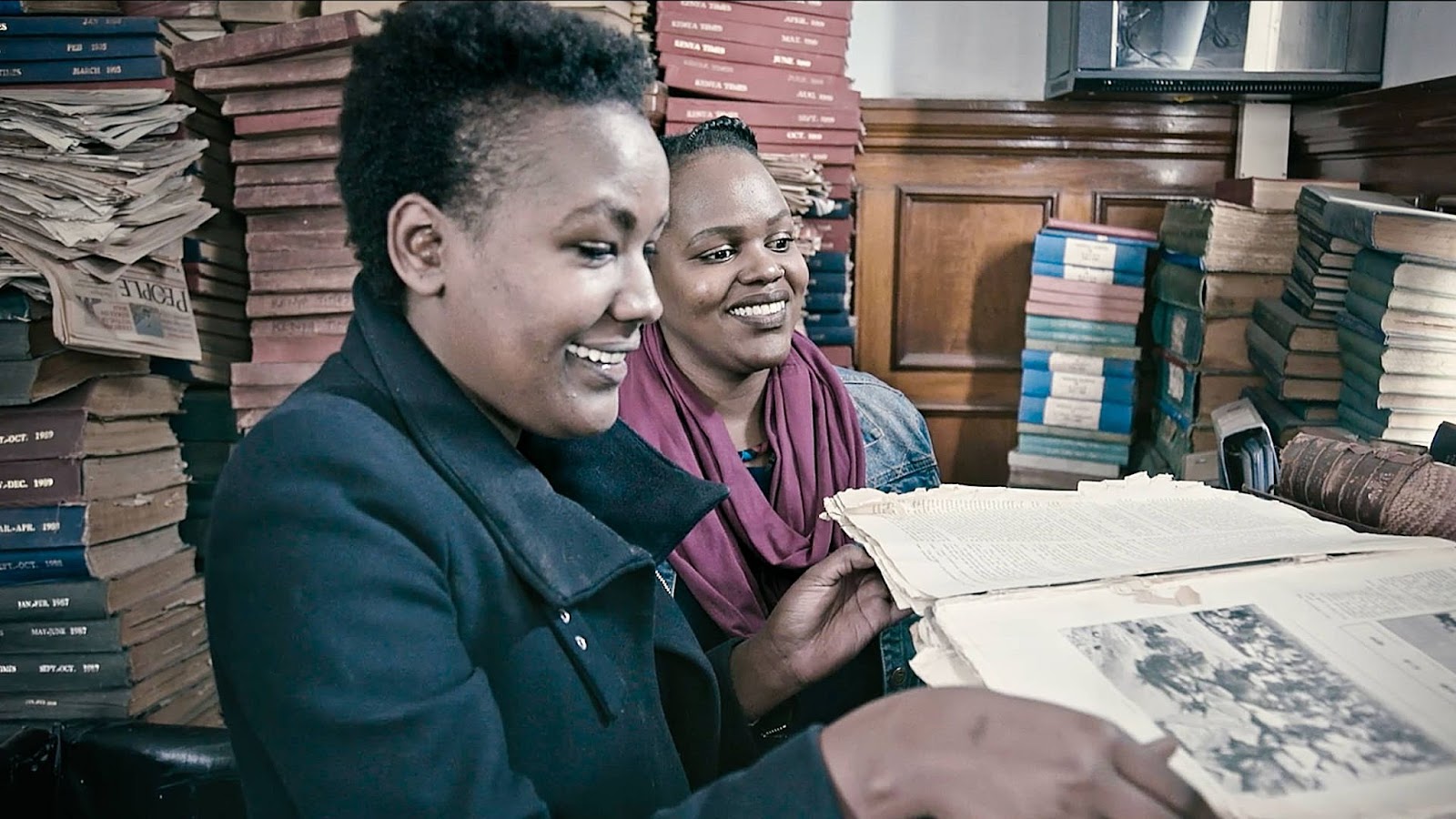

For 8 years, the Nairobian husband and wife filmmaking team, Maia Lekow and Christopher King (The Letter) documented the restoration of Kenya’s second-oldest library. But this wasn’t just an architectural venture. The two women helming the project, writer Shiro Koinange and publisher Angela Wachuka, were motivated by their love of literature and learning and their mission to unite the Kenyan community through storytelling. This resulted in the beautifully-crafted How to Build a Library, one of the year’s must-see films.
McMillan Memorial Library was built in Kenya’s capital city of Nairobi by Lady Lucie McMillan to honor her late husband, William Northrup McMillan. When it opened in 1931, it was initially for whites only, which didn’t change until the end of apartheid in 1962. It was bequeathed to the Nairobi City Council and opened to the public. The building and its collections, dating back to the early 1900s, were neglected for decades.
While scouting for a venue to host a literary festival, Shiro and Wachuka saw the library’s decrepit state and set out to restore and update the space. In October 2017, the two founded Book Bunk, leaving their full-time jobs to focus on the massive, multi-year project, and in 2018, Shiro and Wachuka formally partnered with the Nairobi City County government. The project also included an overhaul of McMillan’s other branches, Kaloleni Library and Eastlands Library in Makadara. They began with these two branches located in low-income neighborhoods, making sure the local residents have resources.
The documentary follows the two passionate women as they gather a team of artists, intellectuals, authors, and workers to rebuild and redefine what these libraries mean to the community. As Wachuka told The New York Times in 2023, their mission was to “subvert its intended use.” That required researching the libraries’ current demographic, if/why they visit (or don’t visit) the libraries, what they find problematic about its collections, and how they’d like it to change. One glaring problem is the lack of African authors and the abundance of white authors.
The documentary features interviews with library patrons from different generations who have fond memories of the libraries and are disappointed that they haven’t evolved with the city. Some rooms house piles of broken furniture, damaged books, and years of dust.
As the Book Bunk team goes through the thousands of books, records, photos, artwork, and other artifacts, they’re confronted with the library’s colonial legacy. Some scenes are intercut with archival footage of British royals visiting Kenya as well as the violence of during their rule.
A very poignant moment that struck me was when they came across a photo from 1907 labeled “the first hanging in Kenya.” Syokau Mutonga, Book Bunk’s research and inventory manager, wonders if she should feel angry about the atrocities committed or grateful that the white men took better care of preserving the library than the Nairobi government. During a discussion after a screening event of colonial history, one person suggested renaming the library after an African artist or academic, instead of the white man it was built to honor.
Lekow and King present other perspectives outside of Book Bunk, namely the librarians who felt overlooked and underappreciated during the process. One point of contention is utilizing the Dewey decimal system versus a more inclusive system that doesn’t have African languages as a subcategory. Both sides make solid arguments about the need to update the system to reflect modern times as well as not wanting to completely change what’s already in place (and I don’t envy anyone making that decision).
Despite the many trials and tribulations, the documentary also shows the celebration of reclaiming these spaces. From glamorous fundraising galas celebrating the revitalization of African culture and the arts to more intimate moments of joy, How to Build a Library paints a picture of a complex yet exciting journey.
The bureaucracy surrounding the project is both fascinating and infuriating, and the vibrance of the community is a nice contrast. It’s also interesting to watch the planning and organization of the various programming and events (discussions, screenings, workshops, readings) and how each one presents different challenges.
How to Build a Library is a fascinating exploration of Kenyan culture through the lens of artists working to restore and decolonize spaces for people to learn, create, inform, and share. The film captures the joy and comfort of going to a library either as a kid doing homework or as an adult seeking information.
While seeing the libraries in their previous dilapidated states is disheartening, watching the hard work that went into restoring them is incredibly moving as is Shiro and Wachuka’s passion and perseverance. I see it motivating many viewers to make a trip to their own local libraries.
How to Build a Library premiered January 26 at the 2025 Sundance Film Festival in the World Cinema Documentary Competition.