
***
Republished from 2013
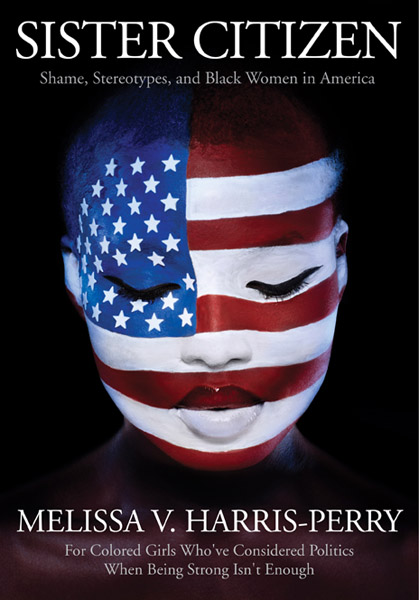
Sister Citizen: Shame, Stereotypes, and Black Women in America by Melissa Harris-Perry is an eye-opening examination of the labels historically placed on Black women and how those same labels continue to shape and constrain the lives of African-American women today. Drawing from a political science framework, Harris-Perry uses empirical data, surveys, and focus groups to support theories that have profoundly influenced Black women’s experiences for centuries.
Harris-Perry opens with the story of “The Hurricane” from Zora Neale Hurston’s Their Eyes Were Watching God — centering on the protagonist Janie and her struggle with self-identity in a world where her Black womanhood makes her vulnerable to people and systems designed to suppress her. Janie’s story resonates deeply with the contemporary Black woman’s experience because the stereotypes and patterns of misrecognition Hurston depicted remain very much alive today.
In Sister Citizen, Harris-Perry introduces the concept of the Crooked Room as a metaphor for the oppressive landscape Black women must navigate, one in which harmful stereotypes like Mammy, Jezebel, and Sapphire have taken root since the era of slavery. While these archetypes may seem outdated, they continue to surface in reality television, music videos, film, and the careless commentary of political pundits and journalists who use these damaging clichés either with racist intent or simply to provoke a reaction.
What struck me most — and felt most personal — was Harris-Perry’s exploration of misrecognition. As a nerdy Black girl growing up, I often felt invisible, as though my particular way of moving through the world didn’t register. I was the uncool one; the other Black girls around me seemed cool, confident, and socially magnetic. Looking back, I wonder how many of them were quietly inhabiting their own crooked rooms — performing an identity that felt safe and legible to others, setting aside their genuine interests to fit within a narrow definition of Blackness. I tried, at times, to hunch my back and blend in. It never worked. They always saw through it.
Misrecognition is just one of many threads Harris-Perry weaves through this rich analysis. Among the book’s most compelling sections is a chapter on Michelle Obama and the relentless media scrutiny she faced as America’s first African-American First Lady. Rather than bend under the pressure, Michelle Obama chose to stand tall, refusing to shrink herself to satisfy others’ expectations. That kind of resistance is at the heart of what Sister Citizen is about.
Much of what Harris-Perry uncovers wasn’t surprising to me, the harmful images, the social conventions, the double standards. What I did gain was a deeper understanding of why women still internalize these models, and how both Black men and white Americans reinforce them whenever a so-called scandal arises — as in the case of Shirley Sherrod, whose comments about a white farmer were swiftly and viciously distorted by both the media and the NAACP.

Sister Citizen is an enlightening, necessary read. It illuminates the mechanisms behind the stereotypes that persist in our culture and invites us to interrogate our own relationship to them. The book closes with a quote from Shirley Chisholm — the first Black woman elected to Congress and the first to seek the U.S. presidency — that captures its spirit entirely:
“I want history to remember me not just as the first Black woman to be elected to Congress, not as the first black woman to have made a bid for the presidency of the United States, but as a black woman who lived in the 20th century and dared to be herself.
Being yourself. That is exactly what it means to stand straight in the crooked room.